

How could we have imagined Nigerian Pidgin being the language used in the actual message, but it definitely proved the reason why the language was used, keeping the message encrypted and safe for 77+ years, till now!
Were a few of the attendees at the Lapstone Conference in the Blue Mountains of New South Wales tasked with covertly getting the cleanup of Australia’s information leakers started?
Back to Contents Page
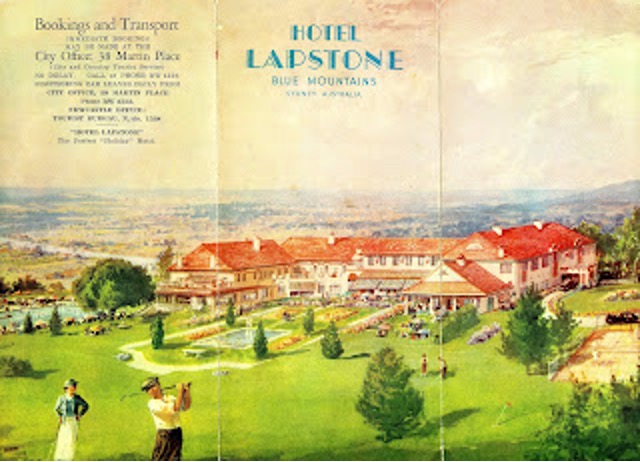
Conference details:-
The Lapstone Conference was the fourth session of the United Nations Economic Commission for Asia and the Far East (ECAFE). It opened on November 29, 1948 at the Lapstone Hotel in the Blue Mountains, and ran till about December 13, 1948 with the significant delegates only present from November 30 till December 2, 1948. (Note: A separate UNRRA conference occurred in Lapstone in February 1945, but the 1948 event is the primary one referred to as the “Lapstone Conference.”)
- Dates: 29 November – 13 December 1948 (opened on 29/30 November, closed around 12–13 December).
- Location: Lapstone Hotel (a luxury resort in the lower Blue Mountains, about 60 km west of Sydney). Delegates were also accommodated at nearby hotels like the Hydro Majestic due to space constraints.
- Host: Australia (under the Chifley Labor government).
- Participants: Approximately 110 delegates from 18 countries and territories, including:
- Full members: Australia, China (Republic of), France, India, Netherlands, New Zealand, Pakistan, Philippines, Thailand, UK, USA, USSR.
- Associate members/new admissions: Republic of Indonesia and Indonesia (newly admitted as associate members), Burma, Ceylon (Sri Lanka), Cambodia, Hong Kong, Laos, Malaya and British Borneo, and Nepal.
- Observers from other UN bodies and colonial administrations.
- Australian Delegation Lead: Dr. H.C. (“Nugget”) Coombs (Director-General of Post-War Reconstruction, later Governor of the Reserve Bank).
Purpose and Context:-
ECAFE was one of the UN’s earliest regional economic commissions (established March 1947) to promote post-war economic recovery and cooperation in Asia and the Far East — a region devastated by Japanese occupation, colonial wars, and emerging independence movements.
The 1948 session focused on:-
- Rebuilding war-torn economies (infrastructure, trade, industry).
- Technical assistance and development planning.
- Flood control, rice production, and industrial rehabilitation.
- Admission of newly independent or emerging nations.
Major Controversy and Outcome:-
- The most dramatic moment was the admission of the Republic of Indonesia as an associate member (despite ongoing Dutch-Indonesian conflict — the Dutch were still trying to re-assert colonial control after Japan’s defeat).
- The Netherlands delegation walked out in protest when Indonesia was granted associate membership status.
- This reflected Australia’s strong support for Indonesian independence (under Foreign Minister Dr. H.V. Evatt’s anti-colonial stance) and marked an early Australian assertion of an independent foreign policy in Asia.
Other Notable Aspects:-
- Soviet Delegation Drama (later highlighted in ASIO/MI5 files): The USSR sent 14 delegates, but two (Mr. Sherbakov and Miss Bogotyreva) reportedly never appeared at the conference and remained in Australia (fueling Cold War-era espionage suspicions, including links to the Somerton Man mystery theories).
- The conference required significant alterations to the Lapstone Hotel (government-funded), which later became a point of political debate in Parliament.
- It was one of the last major events at the hotel before it was acquired by the RAAF in 1949 and turned into an Officers’ Mess (now part of RAAF Base Glenbrook).
Earlier Lapstone Conferences (for context):-
The Lapstone Hotel hosted several international gatherings:
- 1938: British Commonwealth Relations Conference (pre-war, unofficial Chatham House event).
- February 1945: UNRRA (United Nations Relief and Rehabilitation Administration) Far Eastern Regional Conference.
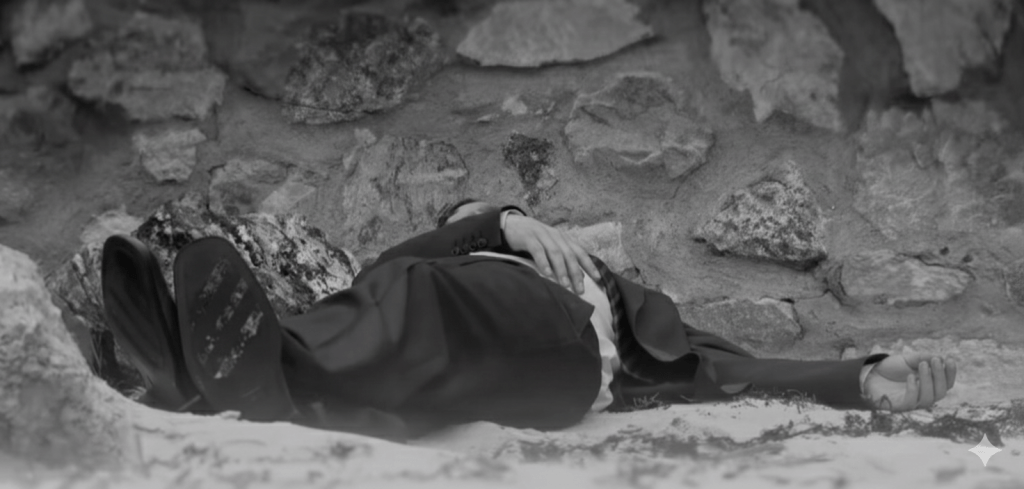
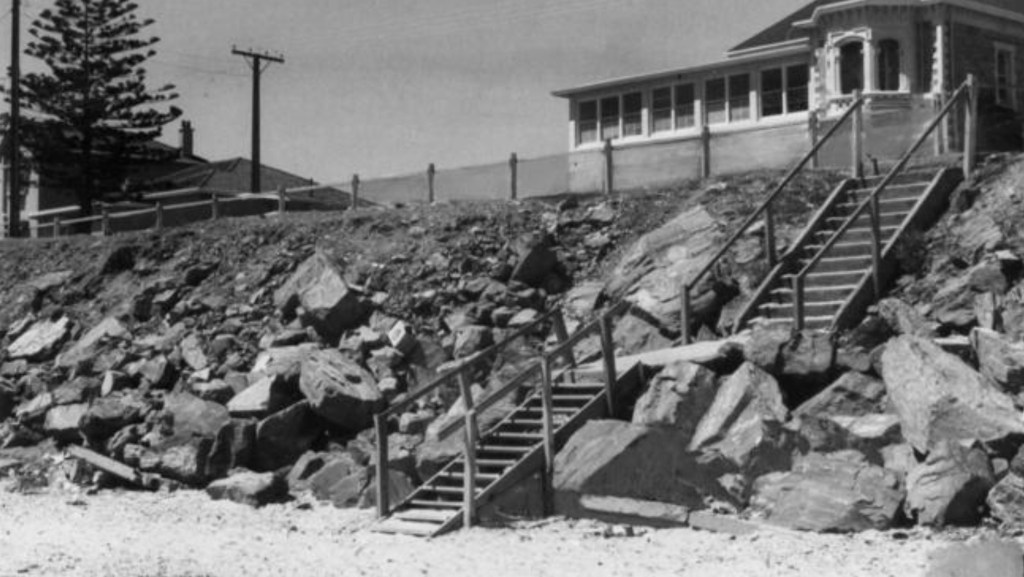
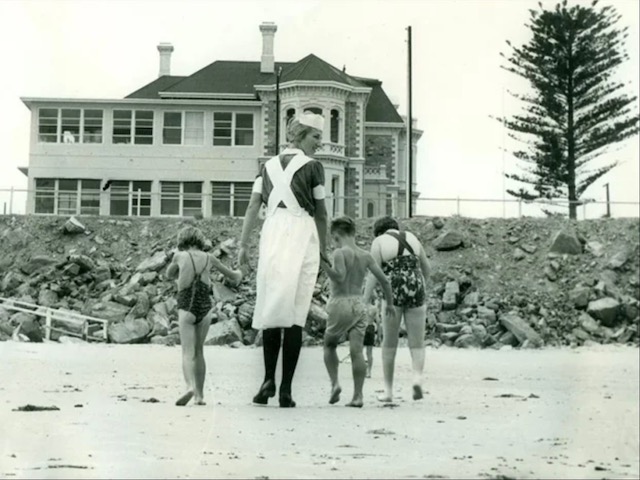
But taking place at the same time in Adelaide, on Somerton Beach:-
and also the Illuminating Engineering Society of Australia (S.A. Section):-
…….. were holding their Annual Conference Dinner at the Adelaide Town Hall on the first evening prior to the Conference taking place in the forthcoming days. This Dinner was held on the evening of Tuesday the 30th of November 1948 with the activities starting the following day being Wednesday the 1st of December 1948. Adelaide Town Hall was the venue, with accommodation allocated around various Adelaide hotels.
On inquiry, the Society (which still exists in similar format) advises that any records of membership or conference attendees are long gone.
The So-Called Laundry Marks!

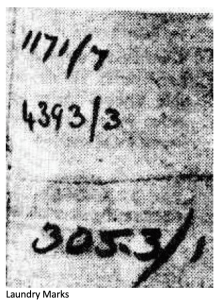
Markings (above) found on the inside lining of a trouser pocket of the items found in a suitcase supposed to belong to Somerton Man. These were referred to as the laundry marks.
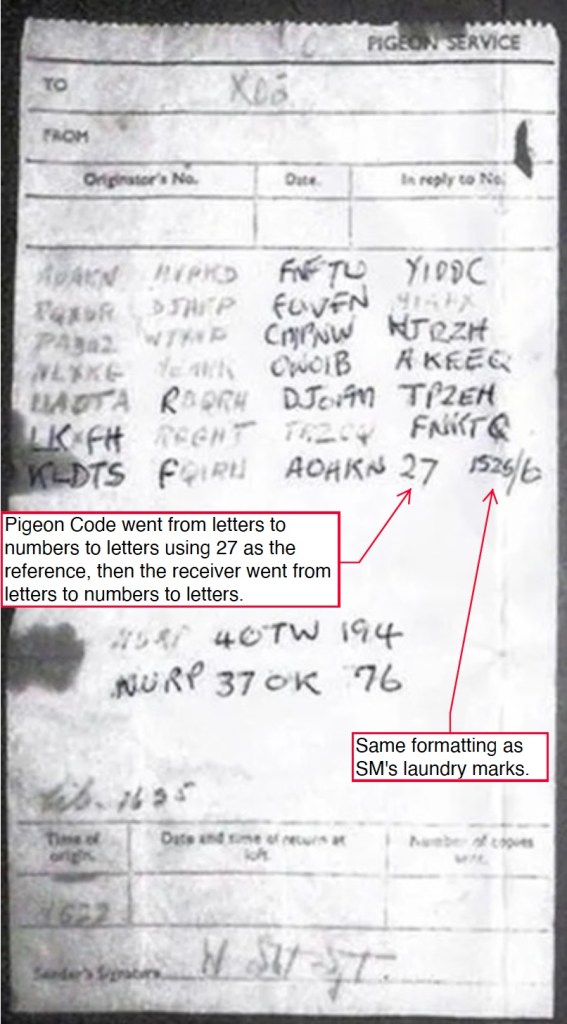
This is a copy (above) of the actual Pigeon Code which is yet to be decrypted. This was found in a boarded-up fireplace years after it was sent. The page was still in the red capsule attached to the leg of a pigeon skeleton and is truly a one-time pad where the sender burns his page when sent, and the receiver burns his page when decrypted.

For an understanding of the functionality of the “One Time Pad” system, which was used for message transfer during the “D Day Invasion of Normandy” to free France from German occupation, search for “The Pigeon Code”.
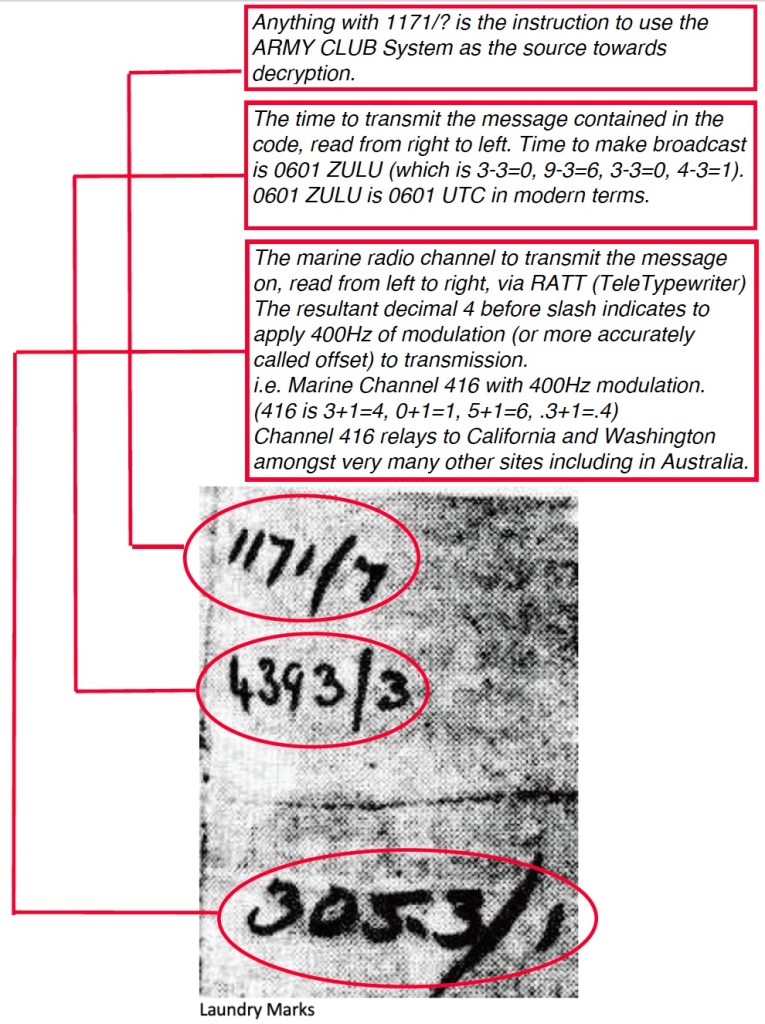
As every “One Time Pad” needs both a pad and a key, the pads in the Somerton Man saga are the Kensitas #7 Carnation Collectors’ Card for the first and second lines, and the Army Club packet for the third and fourth line. The key was the existence of 7 Kensitas cigarettes.
The Kensitas Flowers Collector cards were distributed within the Kensitas cigarette packets of the time.
Even though it uses “One Time Pad” principles, the Army Club Code System was re-used many times around mid to late 1945 – early 1946 then abandoned once it started to attract interest after showing up in several crimes including the elimination of Saul “George” Marshall in Sydney, thereby “outing” General George Catlett Marshall US who was in command of the secret supply of materials and equipment to the Pacific Atomic activity. It would re-appear in late 1948 briefly.
And appearing in copies of the Whitcombe and Tombs (NZ) Ltd “The Rubaiyat of Omar Khayyam,” the code had similarities to “George” Marshall’s death in Sydney to the passing of the Somerton Man in December 1948 and Jennie (Joan, Johanna) (Friedman, Freeman) Laidlaw in Westminster, London in May 1953.
Author’s note:- If 8 Scrabble tiles were chosen randomly and thrown in the air, on landing and given enough attempts, at some point the tiles may spell out a word.
On reading the decryption of the second line of code in isolation, some could argue the Scrabble principle applies to the line 2 decryption.
However:- the author would hope that line 2 of code, when read in context with the actual pigeon code applied to line 1 (and similarly applied to line 2) would match the content, intent and context of the full first 2 lines of the 4 line message, and it being in Nigerian Pidgin.
TO THE SOMERTON MAN CODE:-
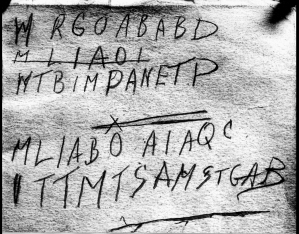
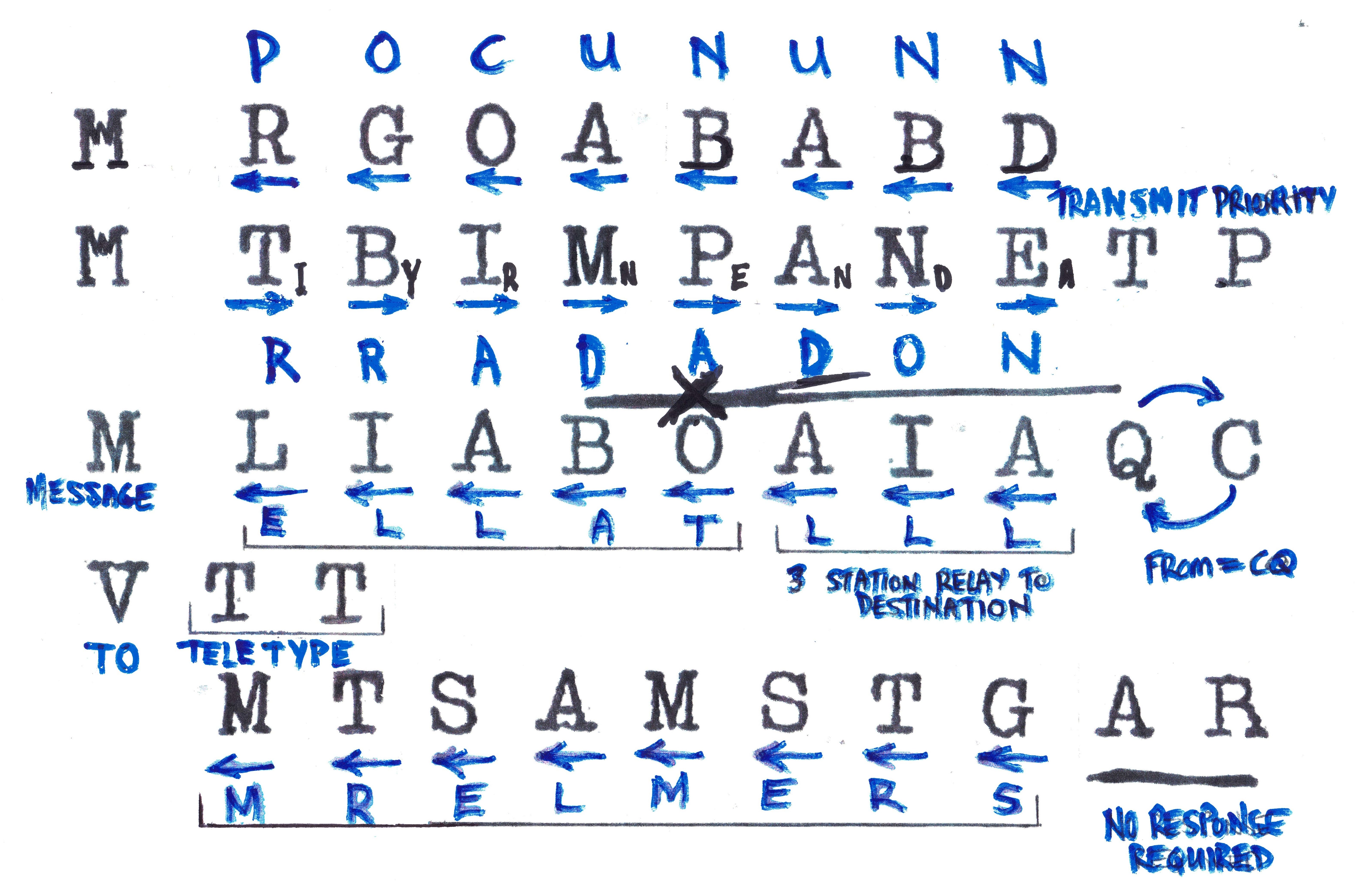
The letters and layout of the code page (above) were obtained by rubbing a lead pencil (laying nearly horizontally to provide a wide lead surface) over the seemingly blank page revealing the pen stoke indentations.
The Code:-
The first two M’s looked from the start as not just M’s but a signal that there was some skipping involved, or some other symbol known only to the group, as the middle of these M’s didn’t reach the bottom and what is more important is that they had deliberately been written this way.
Were they to signify the letter “N” for Nigerian?

The last M was clearly just M for Message.
The 4 lines of the message text are basically 8 letters long with some other letters added before and after, where required, for an action to be done.

7 Kensitas cigarettes.
Firstly, for the top 2 lines, the Kensitas Collector Card (#7 Carnation) was used and the lower 2 lines used the front face of the Army Club cigarette packet itself.
There were 7 x Kensitas cigarettes left in the SM Army Club packet.


The people involved used this “One Time Pad” type of code many times, not just the once.
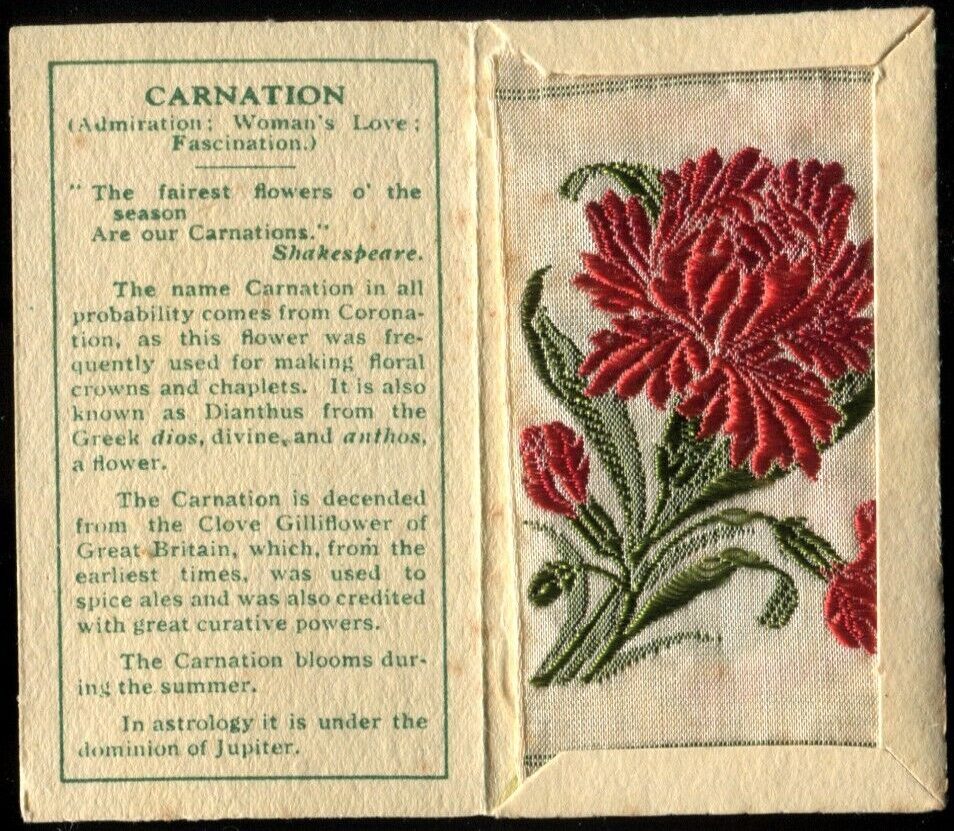
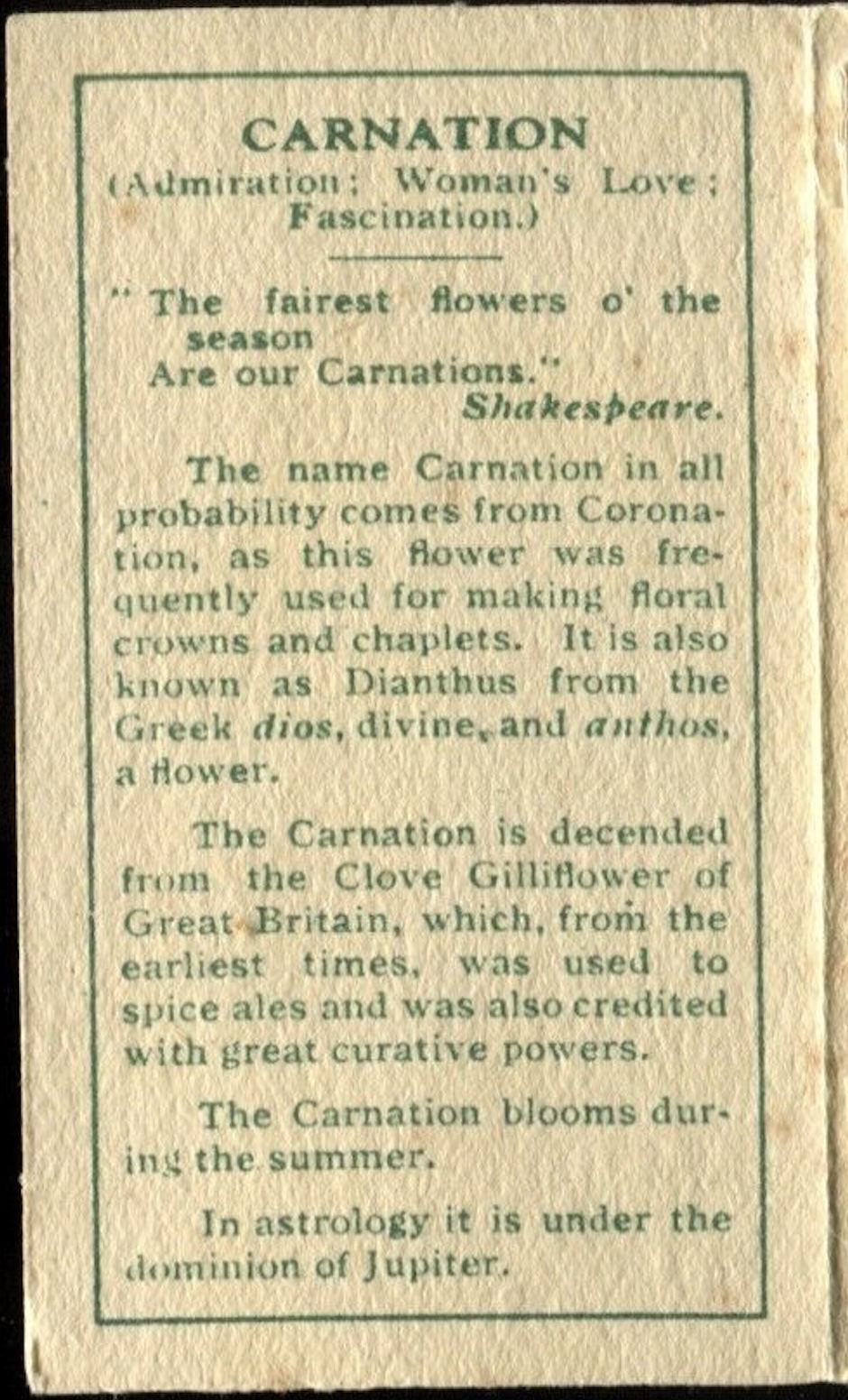
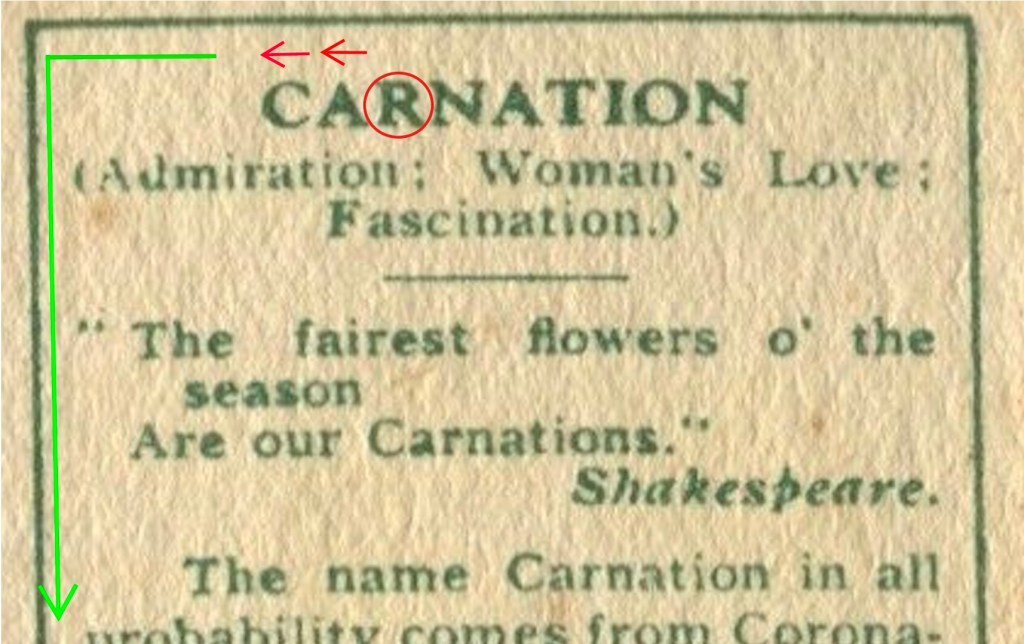
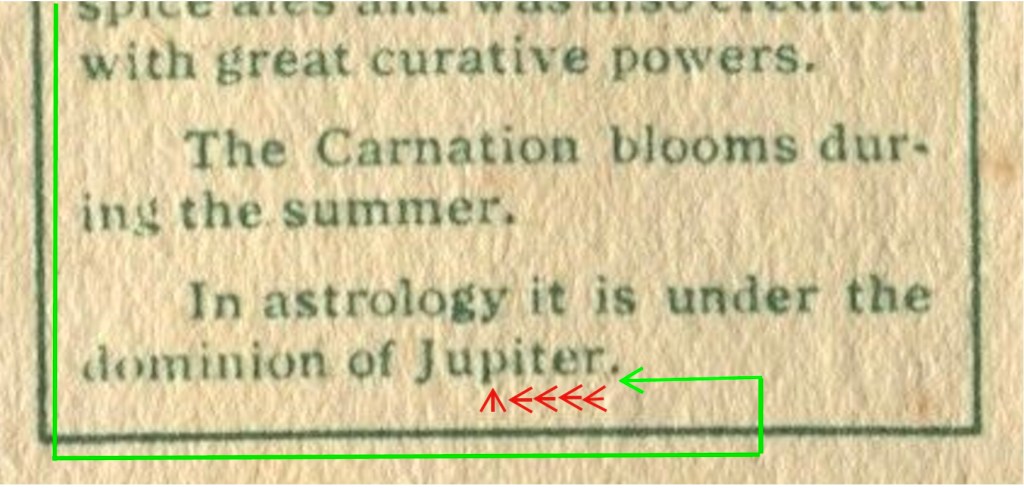
The first and second lines of the code were lifted from the inside left page of the Kensitas Carnation Card (below), reading from the target letter 7 spaces to the left or right, with the second line transcribed twice.
The third and fourth lines of the code use the top line (Army Club), then the block to the right of the shield, then the lower text, but moving in a leftward (anticlockwise) direction (below).


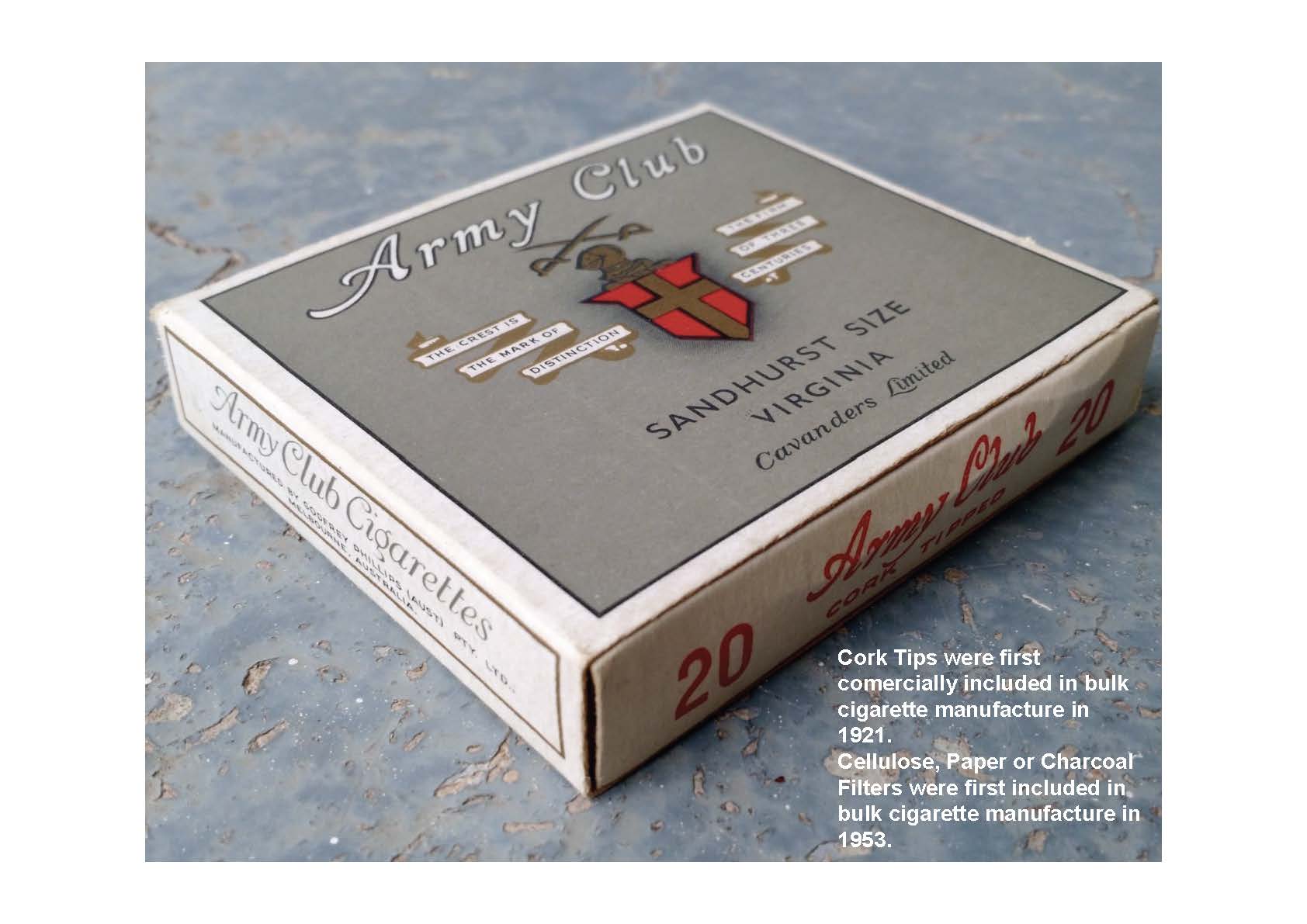
Godfrey Phillips started making and packaging Army Club Cigarettes under license in Australia in 1930 and the code participants were operating in Australia, so an Australian packet was used.
At the halfway point, the X means to switch the source you take the readings from. i.e. the Kensitas Card swaps to the Army Club packet.
Also of note: – It is unlikely the writer would disguise her name by encryption as the sender in/of the code in line 3 and then write her phone number in normal text mode on the same page, so the phone number found by Police had to be written for later reference, and most likely by Police themselves!

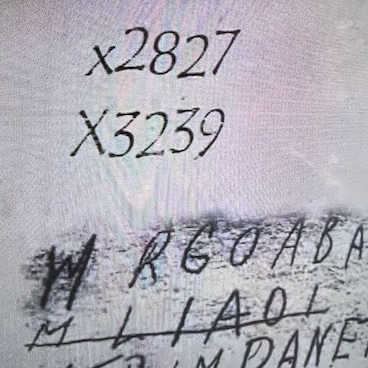
x3239 is Jessica and Prosper
OK, then let’s break it down!
The methodology is consistent across the whole code, and that is to start at the first occurrence of each code letter on the card or packet and move in an anticlockwise (left) direction for lines 1, 3 and 4 and to the right twice for line 2.
To download a copy of this code page (above) as a picture, click here:- Code
Top Line:-
<- The first R in the top code line is the third letter in CARNATION. As the arrow points left you go anticlockwise. The R starts next at A, and then C, then r in Jupiter, then e, then t, then i, then p, so R becomes P. (see below)
<- The G in the top code line is the g in making. As the arrow points left you go anticlockwise. The G starts next at n, and then i, then k, then a, then m, then r, then o, so G becomes O. (see below)
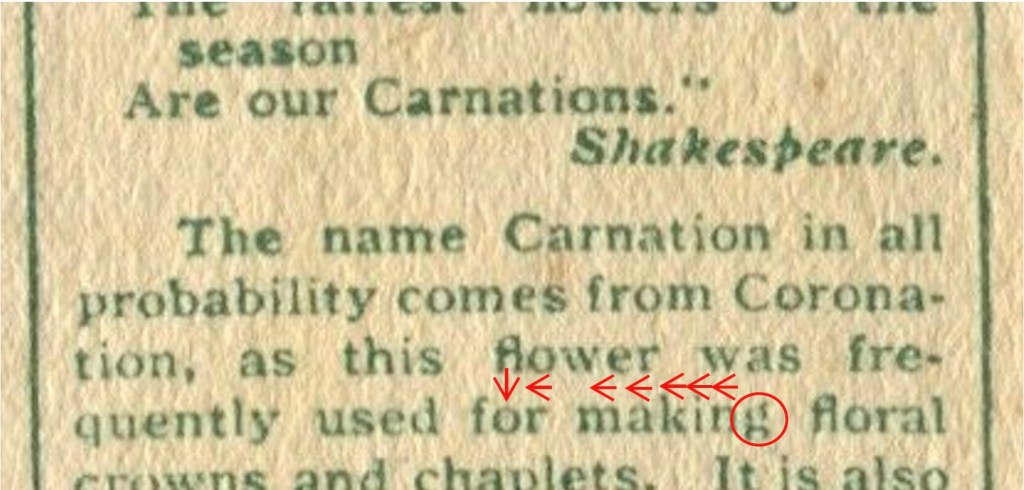
Then carry on in a similar manner to above.
<- The O in the top code line is the O in CARNATION. As the arrow points left you go anticlockwise. The O starts next at I, and then T, then A, then N, then R, then A, then C, so O becomes C.
<- The A in the top code line is the A in CARNATION. As the arrow points left you go anticlockwise. The A starts next at C, and then r in Jupiter, then e, then t, then i, then p, then u, so A becomes U.
<- The B in the top code line is the first b in probability. As the arrow points left you go backwards. The b starts at o, then r, then p, then l in all, then l again, then a, then the seventh letter to the left is n. So B becomes N.
<- The second A in the top code line is the A in CARNATION. As the arrow points left you go anticlockwise. The A starts next at C, and then r in Jupiter, then e, then t, then i, then p, then u, so A becomes U.
<- The second B in the top code line is the first b in probability. As the arrow points left you go backwards. The b starts at o, then r, then p, then l in all, then l again, then a, then the seventh letter to the left is n. So B becomes N.
<- The D in the top code line is the d in admiration. As the arrow points left you go backwards. The d starts at A, then N in CARNATION, then O, then I, then T, then A, then the seventh letter to the left is N. So D becomes N.
Second Line:-
The second line is completed twice and to the right:-
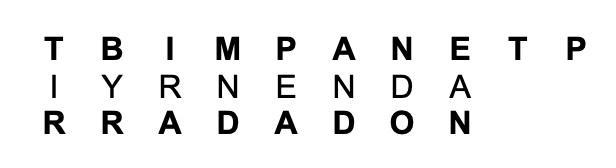
-> The T in the second code line is the T in CARNATION. As the arrow points right you go forwards. T starts at I, then O, then N, then A, then d, then m, then the seventh letter to the left is i. So T becomes I.
-> The B in the second code line is the b in probability. As the arrow points right you go forwards. b starts at a, then b, then i, then l, then i, then t, then the seventh letter to the right is y. So B becomes Y.
-> The I in the second code line is the I in CARNATION. As the arrow points right you go forwards. The I starts at O, then N, then A, then d, then m, then i, then the seventh letter to the right is r. So I becomes R.
-> The M in the second code line is the m in Admiration. As the arrow points right you go forwards. M starts at i, then r, then a, then t, then i, then o, then the seventh letter to the right is n. So M becomes N.
-> The P in the second code line is the p in Shakespeare. As the arrow points right you go forwards. P starts at the e, then a, then r, then e, then T, then h, then the seventh letter to the left is e. So P becomes E.
-> The A in the second code line is the A in CARNATION. As the arrow points right you go forwards. A starts at R, then N, then A, then T, then I, then O, then the seventh letter to the right is N. So A becomes N.
-> The N in the second code line is the N in CARNATION. As the arrow points right you go forwards. N starts at A, then T, then I, then O, then N, then A, then the seventh letter to the left is d. So N becomes D.
-> The E in the second code line is the E in Love. As the arrow points right you go forwards. E starts at F, then a, then s, then c, then i, then n, then the seventh letter to the right is a. So E becomes A.
Now we get to do the second version of the second line again, and to the right.
-> The I in the second version of the second code line is the I in CARNATION. As the arrow points right you go forwards. The I starts at O, then N, then A, then d, then m, then i, then the seventh letter to the right is r. So I becomes R.
-> The Y in the second version of the second code line is the Y in probability. As the arrow points right you go forwards. Y starts at c, then o, then m, then e, then s, then f, then the seventh letter to the right is r. So Y becomes R.
-> The R in the second version of the second code line is the R in CARNATION. As the arrow points right you go forwards. R starts at N, then A, then T, then I, then O, then N, then the seventh letter to the right is A. So R becomes A.
-> The N in the second version of the second code line is the N in CARNATION. As the arrow points right you go forwards. The N starts at A, then T, then I, then O, then N, then A, then the seventh letter to the right is d. So N becomes D.
-> The E in the second code line is the E in Love. As the arrow points right you go forwards. E starts at F, then a, then s, then c, then i, then n, then the seventh letter to the right is a. So E becomes A.
-> The N in the second version of the second code line is the N in CARNATION. As the arrow points right you go forwards. The N starts at A, then T, then I, then O, then N, then A, then the seventh letter to the right is d. So N becomes D.
-> The D in the second version of the second code line is the d in Admiration. As the arrow points right you go forwards. D starts at m, then i, then r, then a, then t, then i, then the seventh letter to the right is o. So D becomes O.
-> The A in the second code line is the A in CARNATION. As the arrow points right you go forwards. A starts at R, then N, then A, then T, then I, then O, then the seventh letter to the right is N. So A becomes N.
T = TRANSMIT. P = PRIORITY.
X = Change required
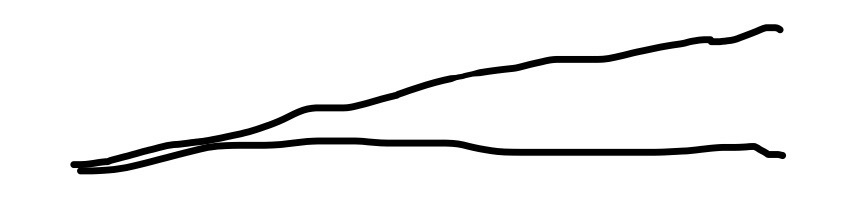
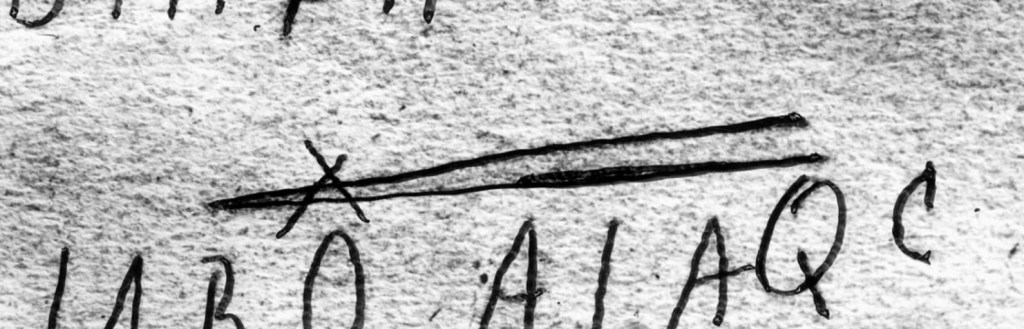
Of interest to note:- Using the Carnation Card and the Army Club packet as described in this post, there is no “X” on either the Card or the Packet to enable an “X” in a message to be encrypted.
Is this the reason the code picture carried this mark? (No X)
Third Line:-
<- The L in the third code line is the l in Club. As the arrow points left you go backwards. The l starts at C, then y, then m, then r, then A, then d (in Limited), then the seventh letter to the left is e. So L becomes E.
<- The I in the third code line is the I in THE FIRM. As the arrow points left you go backwards. I starts at F, then E, then H, then T, then b in Club, then u, then the seventh letter to the left is l. So I becomes L.
<- The A in the third code line is the A in Army. As the arrow points left you go backwards. A starts at the d (in Limited), then e, then t, then i, then m, then i, then the seventh letter to the left is L. So A becomes L.
<- The B in the third code line is the b in Club. As the arrow points left you go backwards. B starts at u, then l, then C, then y, then m, then r, then the seventh letter to the left is A. So B becomes A.
<- The O in the third code line is the O in OF THREE. As the arrow points left you go backwards. O starts at M in FIRM, then R, then I, then F, then E, then H, then the seventh letter to the left is T. So O becomes T.
<- The A in the third code line is the A in Army. As the arrow points left you go backwards. A starts at the d (in Limited), then e, then t, then i, then m, then i, then the seventh letter to the left is L. So A becomes L. **
<- The I in the third code line is the I in THE FIRM. As the arrow points left you go backwards. I starts at F, then E, then H, then T, then b in Club, then u, then the seventh letter to the left is l. So I becomes L. **
<- The A in the third code line is the A in Army. As the arrow points left you go backwards. A starts at the d (in Limited), then e, then t, then i, then m, then i, then the seventh letter to the left is L. So A becomes L. **
QC = CQ (or call originator, from). You may have heard a call something like “CQ CQ this is Shotgun”. This is the same in TeleTypewriter Systems.
** In NTX normally the number of repeater stations a message goes through is indicated by numbers. If it goes through 3 you would see 3 3 3 or 3-3-3. But because this code uses only letters from the cigarette packet (no numerals available), the 3’s are replaced by LLL (= Location Location Location)
Fourth Line:-
V = To
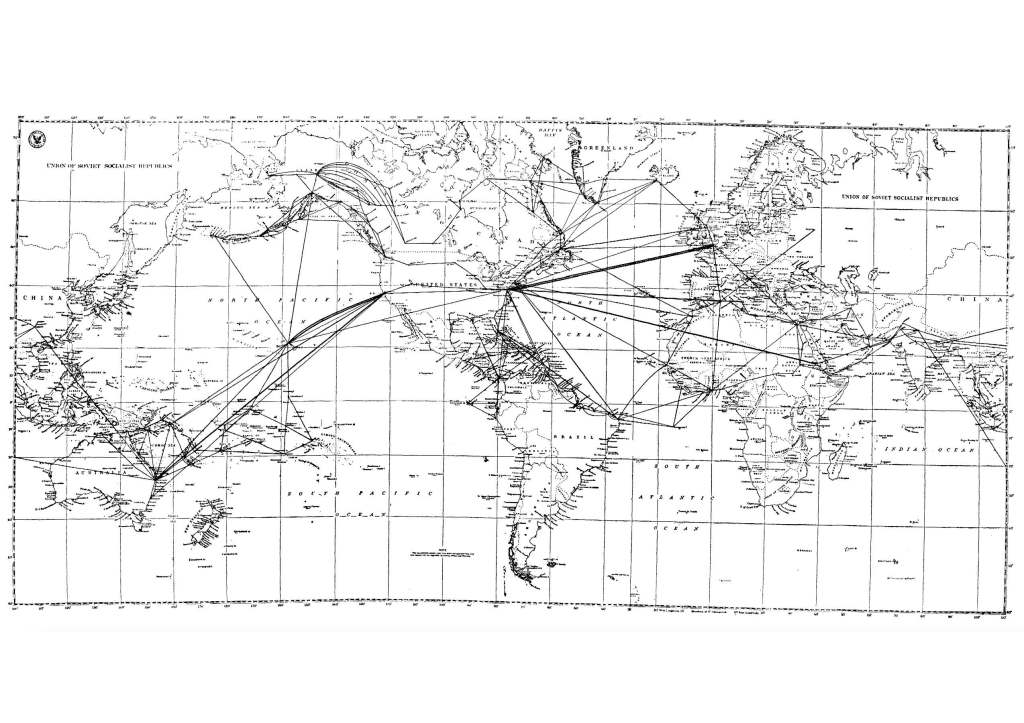
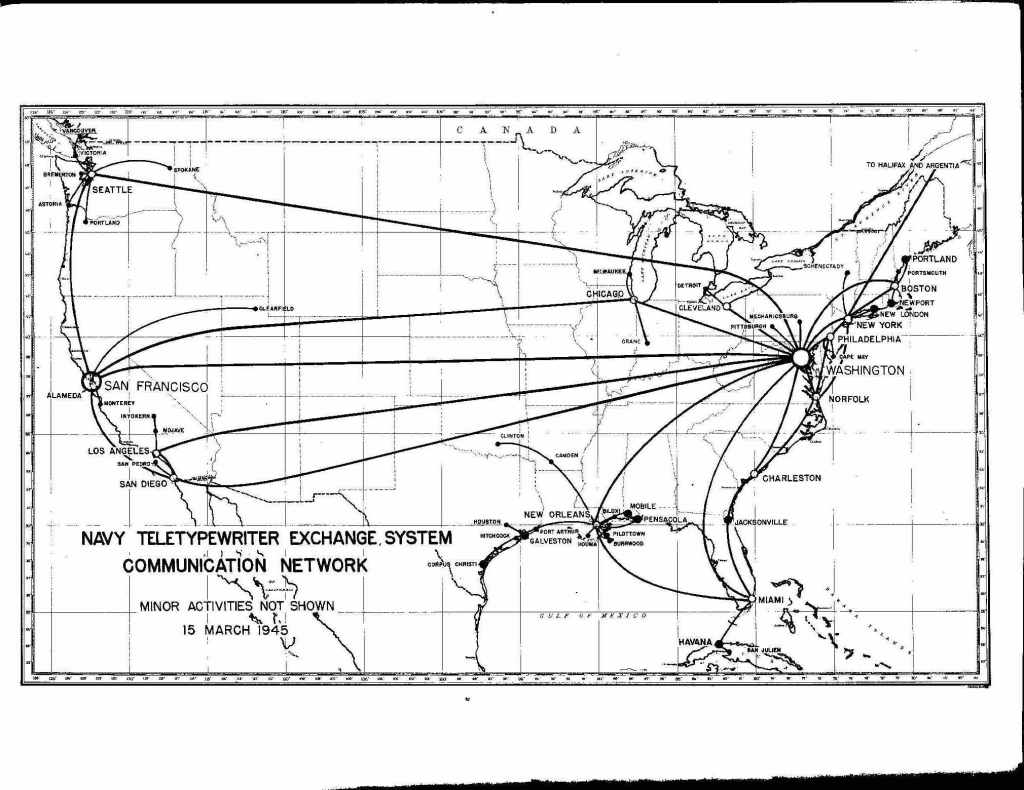
TT = US Navy/Marines TeleTypewriter Exchange System known as NTX.
<- The M in the fourth code line is the m in Army. As the arrow points left you go backwards. M starts at r, then A, then the d (in Limited), then e, then t, then i, then the seventh letter to the left is m. So M becomes M.
<- The T in the fourth code line is the T in THE FIRM. As the arrow points left you go backwards. T starts at b in Club, then u, then l, then C, then y, then m, then the seventh letter to the left is r. So T becomes R.
<- The S in the fourth code line is the S in CENTURIES. As the arrow points left you go backwards. S starts at the E, then I, then R, then U, then T, then N, then the seventh letter to the left is E. So S becomes E.
<- The A in the fourth code line is the A in Army. As the arrow points left you go backwards. A starts at the d (in Limited), then e, then t, then i, then m, then i, then the seventh letter to the left is L. So A becomes L.
<- The M in the fourth code line is the m in Army. As the arrow points left you go backwards. M starts at r, then A, then the d (in Limited), then e, then t, then i, then the seventh letter to the left is m. So M becomes M.
<- The S in the fourth code line is the S in CENTURIES. As the arrow points left you go backwards. S starts at the E, then I, then R, then U, then T, then N, then the seventh letter to the left is E. So S becomes E.
<- The T in the fourth code line is the T in THE FIRM. As the arrow points left you go backwards. T starts at b in Club, then u, then l, then C, then y, then m, then the seventh letter to the left is r. So T becomes R.
<- The G in the fourth code line is the G in VIRGINIA. As the arrow points left you go backwards. G starts at R, then I, then V, then E in SIZE, then Z, then I, then the seventh letter to the left is S. So G becomes S.
AR = End of Transmission or No Reply Required (Same thing)
EXPLANATION: –
PO in Nigerian Pidgin = Person/People, so in this case Po = person.
In slang terms, especially in South African, Nigerian, or general black slang, “CUNUNN” means: –
Ruthlessly clever
Calculating and devious
Someone who plays mind games and always has hidden motives
Will outsmart you in a cold, almost evil way for their own gain
Example:-
Normal cunning: “He’s smart, he negotiated a good deal.” Cununn: “That guy is cununn bro, he smiled in your face while stealing your girl and your money.”
R = as in Are/Has
“RADA DON” ≈ “matter has escalated / something serious has happened”
Think:–
“It’s gone too far now” or “r it gone too far now”
“The thing don serious” or “r thing don serious”
“Trouble don land‘ or “r trouble don land”
or = Things have blown up / it’s serious now
Why it sounds like that:-
rada / radda comes from “rather” (as in “it’s now rather bad”),
don = classic Pidgin marker meaning already / completed / done,
i.e. street slang influenced by Yoruba / urban Lagos talk, where rhythm and emphasis matter more than literal grammar.
Examples:-
As dem start fight, rada don = Once the fight started, all hell broke loose.
You mean dem sack am? Rada don o! = You mean he got fired? That’s serious!
(Very informal. Very street. Very Nigerian.)
Line 1 and 2 message is “Po cununn, r rada don”.
Therefore, lines 1 and 2 mean …….. “Someone we trusted has outed us and it’s over”!
In line 3 CQ = From, and “ELLAT” is Jessica Ellen Thomson (aka EllaT) and “LLL” signifies 3 relays to the recipient. (Location Location Location)
Usually the number of relays would be shown as 3 3 3 or 3-3-3 but this code is only capable of using letters.
In line 4 the V = To and the TT indicates the use of the US Navy Teletypewriter Exchange System (NTX) then follows the actual receiver “MRELMERS” i.e. MR ELMER S.
Therefore, lines 3 and 4 mean …….. From EllaT to ElmerS via Teletypewriter!
The “AR” underlined means a reply is not requested (or end of transmission) depending on which manual you use.
Were there matches or not?
There has been much discussion regarding the existence of a pack of matches found with the other contents of the Somerton Man’s pockets. Some Police statements mention matches were present, but more eliminate the possibility of matches.
Let me paste a scenario in your thinking here:- If the Somerton Man had the Kensitas Carnation Collectors’ Card in his pocket, could it have been mistaken for a book of matches given its similar size?
And, for it to disappear, did one of the attending Officers recognise what this small item was, and the significance of why it couldn’t be allowed to remain in existence due to its use in the messaging?
Take me to the Contents Page please!
To backtrack and brush up on what this case is about, go to Wikipedia here
To contact the author email onsomertonbeach@onsomertonbeach.com


Leave a comment