

Could we have missed something that was sitting there, right in front of us?
Back to Contents Page

Should it have been as plain as the nose on your face?

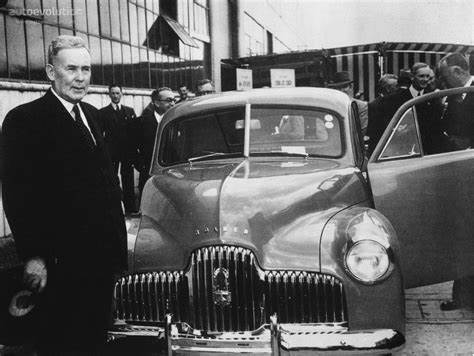
🏭 GMH Fishermans Bend in 1948
The launch for the first Australian produced Holden was held at the GMH Plant at Fisherman’s Bend in Victoria on Monday 29th November 1948. It was marking the first car, a Holden model 48/215, to come off the production line there after previews had taken place the day before at the GMH Woodville plant in Adelaide, South Australia.
In 1948, GMH Fisherman’s Bend was involved in early missile development under the codename “Project Stork,” marking a pivotal moment in Australia’s post-war defence innovation.
The General Motors-Holden (GMH) facility at Fisherman’s Bend in Melbourne played a significant role in Australia’s industrial and defence history. While best known for producing the first Holden car in 1948, the site was also involved in secretive military research and development during the post-war period.
🛰️ Project “Stork” and Missile Development at Fisherman’s Bend
🇦🇺🇬🇧 Project Stork was an early guided missile initiative undertaken in collaboration with the Australian government and defence agencies, and the United Kingdom. It aimed to explore the feasibility of locally developed missile technology in the wake of World War II.
The GMH Fisherman’s Bend site was chosen due to its existing engineering capabilities and proximity to other defence research hubs.
GMH Woodville would duplicate GMH Fisherman’s Bend as a resource to scientific research.
These facilities’ infrastructure and skilled workforce made them an ideal location for experimental defence work, including missile research.
GMH’s collaboration with government defence bodies during this time reflected a broader trend of civilian-industrial support for military technology development in the post-war era.
🛩 The GMH site at Fisherman’s Bend evolved into a centre for advanced engineering and aerospace manufacturing. It later hosted operations for Commonwealth Aircraft Corporation (CAC) and Government Aircraft Factories (GAF).
Aircraft like the CAC Sabre and GAF Nomad were developed and tested in part at Fisherman’s Bend, leveraging the site’s engineering heritage.
🕵️ Legacy and Historical Significance
Though Project Stork did not result in a deployed missile system, it contributed to the technical expertise and strategic vision that would later influence Australia’s participation in global aerospace and defence initiatives.
Fisherman’s Bend continued to serve as a centre for engine production, design, and technical innovation.
While Project Stork itself remains relatively obscure in public records, its legacy can be traced through several key developments in Australia’s defence and aerospace sectors.
🚀 Expansion of Guided Weapons Research
Project Stork (circa 1948) was one of Australia’s first forays into guided missile technology, reportedly involving collaboration between GMH engineers and the Department of Supply.
Though the project did not yield an operational missile, it introduced Australian engineers to missile aerodynamics, propulsion systems, and control mechanisms, which were cutting-edge at the time.
This early experimentation helped seed technical knowledge that would later be applied in more advanced programs.
Now here’s the bit that gets to the nub of the reason this post is relevant to “The Somerton Man”.
🛰️ Transition to Government-Led Aerospace Programs
The Weapons Research Establishment (WRE) in Salisbury, South Australia, was established in 1947 and became the central hub for missile and rocket research. Engineers and scientists with experience from Project Stork and similar efforts likely contributed to WRE’s early work.
WRE would later evolve into the Defence Science and Technology Organisation (DSTO).
WRE was instrumental in projects like:
- Jindivik: A sub-sonic target drone whose development and design commenced in 1948.
- V-2 Rockets: Two German V-2 rockets were brought to Australia around 1947/1948 for technical study and display, marking the start of the Australian rocket range activities.*
- Woomera Test Range: one of the largest land-based test ranges in the world, used for missile and aerospace testing, and nuclear materials and weapons testing.
- Ikara: an anti-submarine missile system.
- Jindalee Operational Radar Network (JORN): a later long-range over-the-horizon radar system.
- Many other rockets and systems.

A Jindivik rocket on display.
*In 1947 and 1948, Australia received two original German V-2 rockets (the world’s first ballistic missile) as part of the allied effort to acquire German technology (Operation Backfire). These rockets were displayed to the public in 1948 and served a crucial instructional and inspirational role for Australia’s new rocket program. They were the original “missiles” that launched the Australian rocket age.
🚀
German V-2 Rocket Influence on Post-WWII Australian Rocketry
The German V-2 (also known as Aggregat 4 or A-4), developed by Wernher von Braun and his team under the Nazi regime, was the world’s first long-range guided ballistic missile, powered by a liquid-fueled engine using ethanol and liquid oxygen (LOx). It reached supersonic speeds (up to 5,760 km/h) and altitudes of 80–100 km, with a range of about 320 km. Deployed from September 1944 to March 1945, it killed over 2,700 civilians in attacks on London, Antwerp, and Paris, but its advanced technology—propulsion, gyroscopic guidance, and supersonic aerodynamics—profoundly shaped Allied post-war rocketry. For Australia, the V-2’s influence was pivotal in establishing the Woomera Rocket Range and the Long Range Weapons Establishment (LRWE, later Weapons Research Establishment or WRE), turning a remote desert site into a hub for guided weapons and space research through captured hardware, documents, expertise, and derivative projects.
Acquisition and Arrival in Australia
Post-WWII, Allied forces prioritized capturing V-2 technology to counter Soviet activities and enhance American advances. Operation Backfire (1945) involved British-supervised firings of captured V-2s in Germany at Cuxhaven, recovering over 100 rockets, components (engines, guidance systems), blueprints, and personnel expertise. This material was analyzed at the Royal Aircraft Establishment (RAE) Farnborough, revealing innovations in liquid propellants, inertial guidance, and telemetry.
Australia received two V-2s as part of this haul:
• One mostly complete rocket arrived in Fremantle (Western Australia) in March 1947, transshipping through Adelaide to Melbourne and Sydney.
• A second, shipped from London aboard the Karamea in February 1947, reached Adelaide’s Outer Harbor in October 1947. It included a rare Meillerwagen mobile launcher trailer.
These were not for live firing but inspection, assembly, and display. The more intact V-2 was examined at the LRWE’s Salisbury facility (near Adelaide) in 1948, where scientists reverse-engineered design elements like the combustion chamber (similar to later Saturn V tech) to inspire local development and generate public interest in rocketry. One was toured nationwide for fundraising, drawing crowds at events like the 1954 Mallala airshow, before both entered storage at the Australian War Memorial in Canberra (one slated for permanent exhibit post-conservation).
Castalloy
Castalloy was established in June 1948 as a subsidiary of Sagar Engineering, based in Waymouth Street, Adelaide, and specialized in high-quality aluminum castings, mainly for automotive uses like engine components for Holden vehicles.

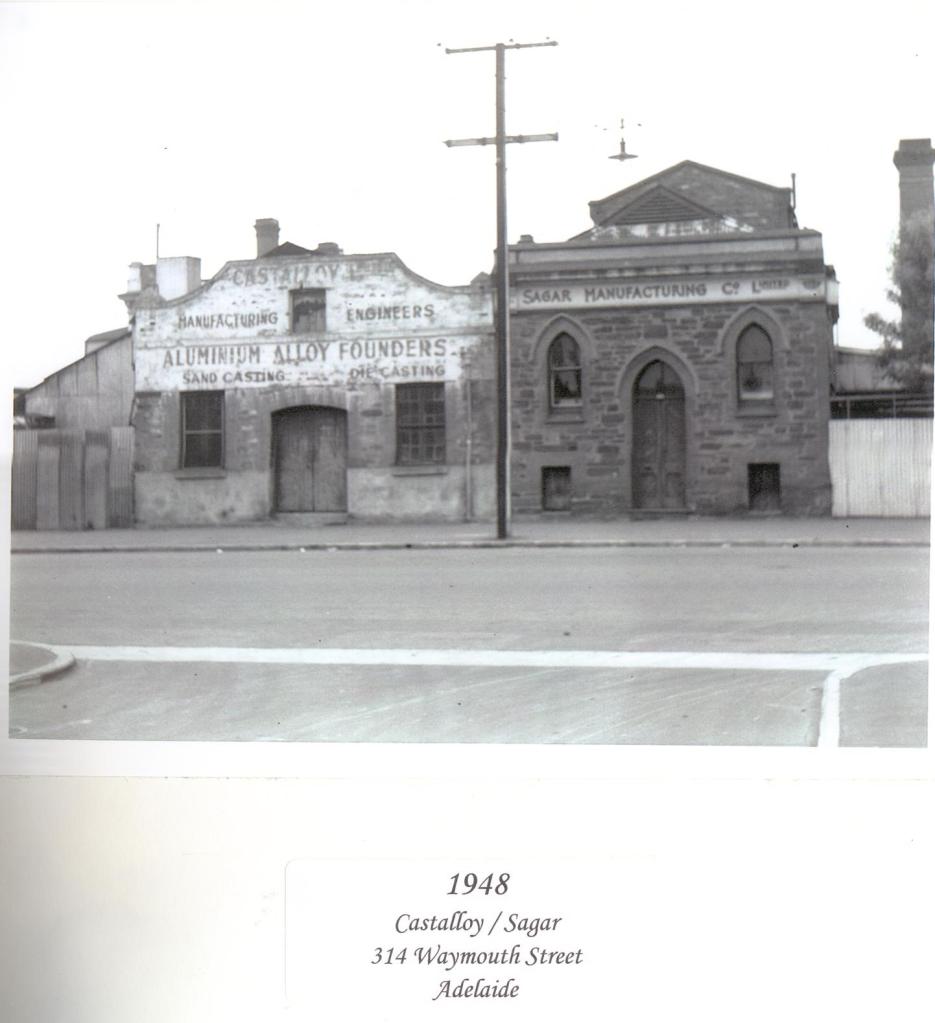
CASTALLOY LIMITED … EARLY HISTORY
In the early 1940’s a small engineering business called SAGAR was established by three men, Eric Scovell, Laurie Green and Bill Rufus, to manufacture grease guns and foot pumps for the handyman and automotive industries.
It derived its name from the first initial of their surnames (S And G And R) and was originally situated at Glen Osmond but soon moved to premises at 314 Waymouth Street, Adelaide.
.
On 25th June 1948 a subsidiary company was formed and given the name Castalloy. Its function was the production of high quality aluminium castings.
In February 1949 Laurie Green transferred to Victoria to set up a subsidiary company and never returned to South Australia as an executive of Castalloy. Henry Frederick “Harry” Phipps, who was in the drawing and design department, was made General Manager, later becoming Managing Director and ultimately Chairman of Directors.
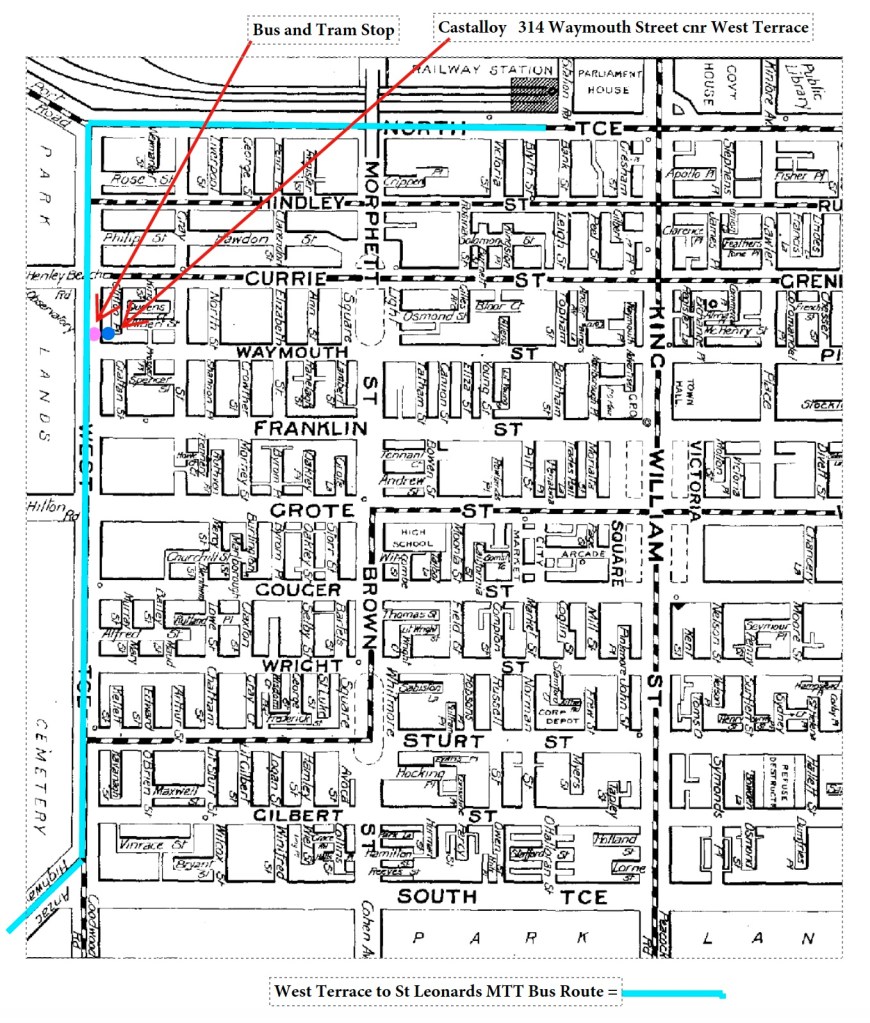
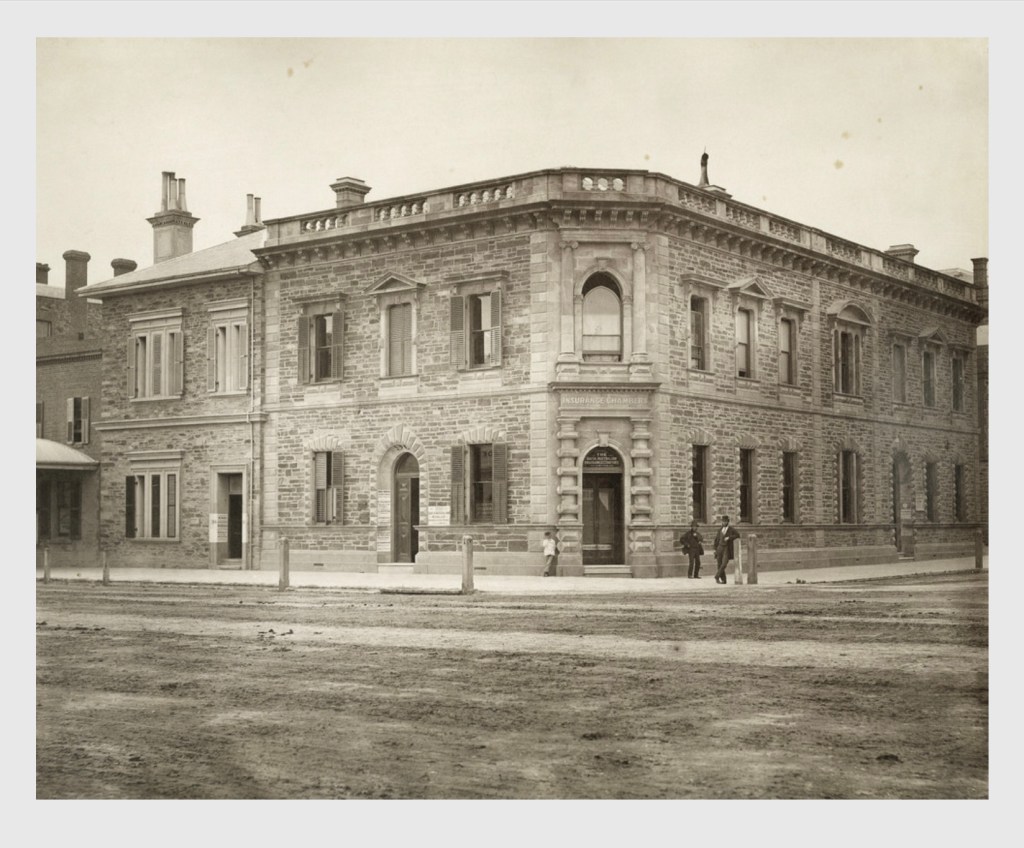
Did a gentleman (loosely speaking) leave the Strathmore Hotel after 4 nights accommodation and buy a Henley Beach train ticket from across the street at the Station? As it was to be only the return trip, he asked not to clip the ticket, he’d do it on the train later.
He then got a taxi (may have been our “George”) from the Station to Castalloy at 314 Waymouth Street, Adelaide.
What did he discuss, and with whom?
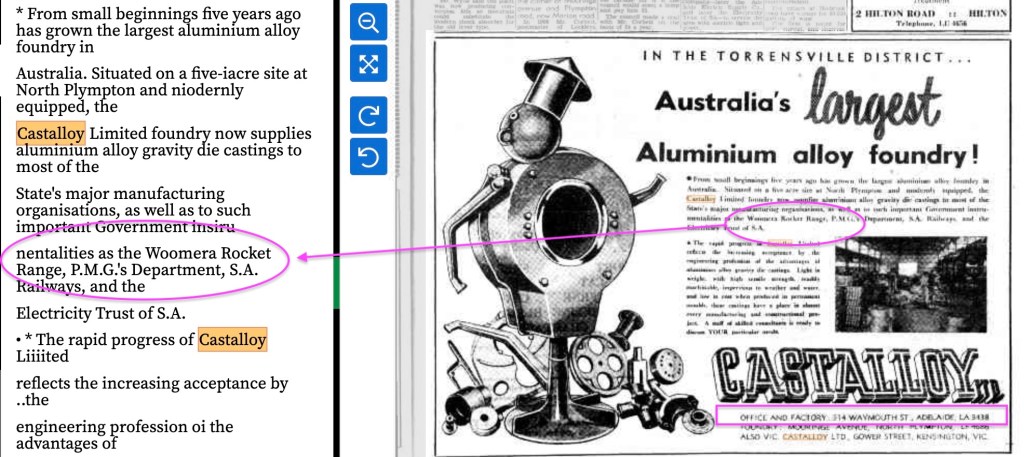
Castalloy would supply parts, cast to order, for the scientists working at the secretive Woomera Rocket Research site as is shown in its records and demonstrated in the advertisements (below).

Our traveller would then catch the St Leonards bus at the bus stop directly outside the Castalloy premises, about 10 steps away.
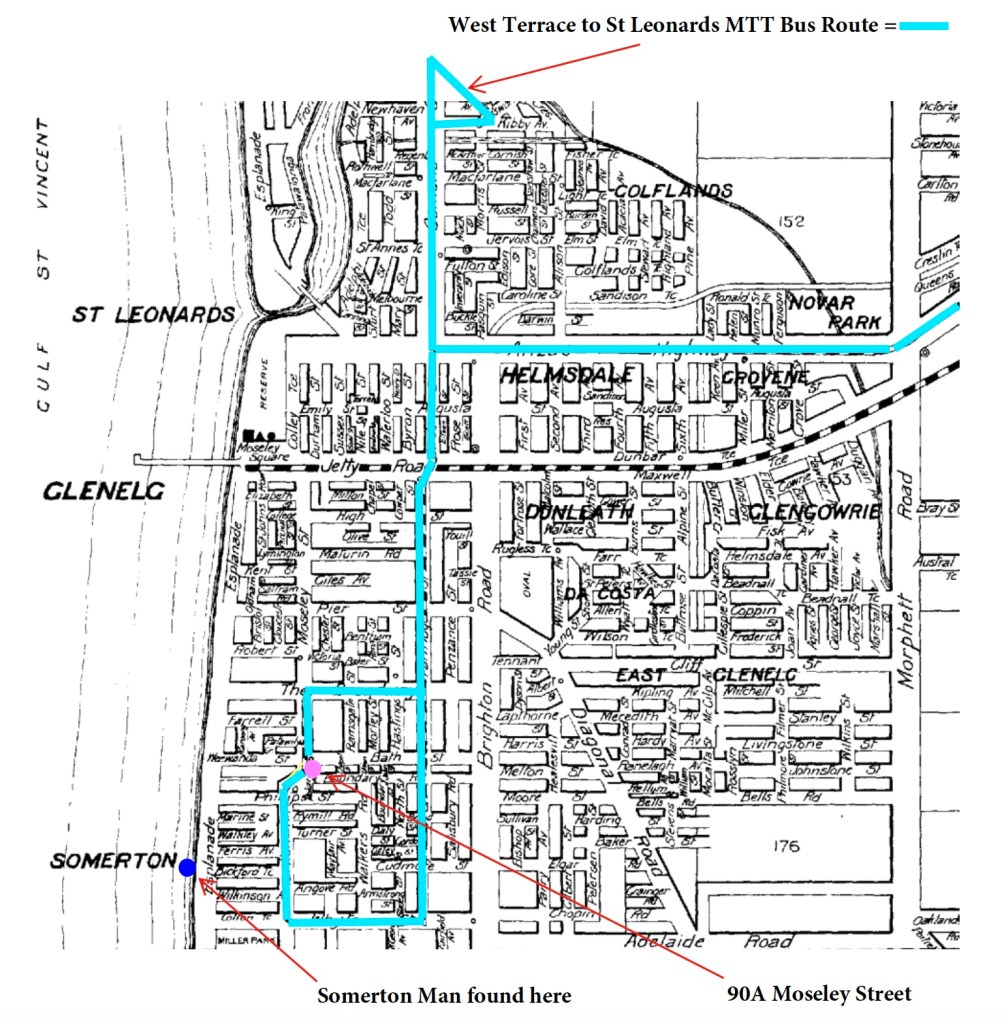
A bunch of white Carnations and the exchange of a piece of paper with some letters on it with Jess, and the request from her to send the message off by Teletype from the Insurance Offices on the corner of Pirie and King William Streets as soon as possible.
Was he then planning his return train trip from Henley Beach via GMH Woodville where he would meet his contact “Max”.
This would be done after his visit to Moseley Street in Somerton.

Did this man (above) play a part in the Somerton Man saga through Castalloy?
Was “Harry” a WHISTLEBLOWER gaining lifelong immunity for him and others?
Did he hold true to his vow of silence?
How did he remain wealthy even though Castalloy had to have multiple cash bail-outs by successive State Governments?
Why did every Premier and Prime Minister of the era endeavour to have their photo taken with this man?
In 1953 a 4.5 hectare site at Plympton, 8 kilometres west of Adelaide, was purchased and all the divisions were transferred to the new site over a period of 8 years.

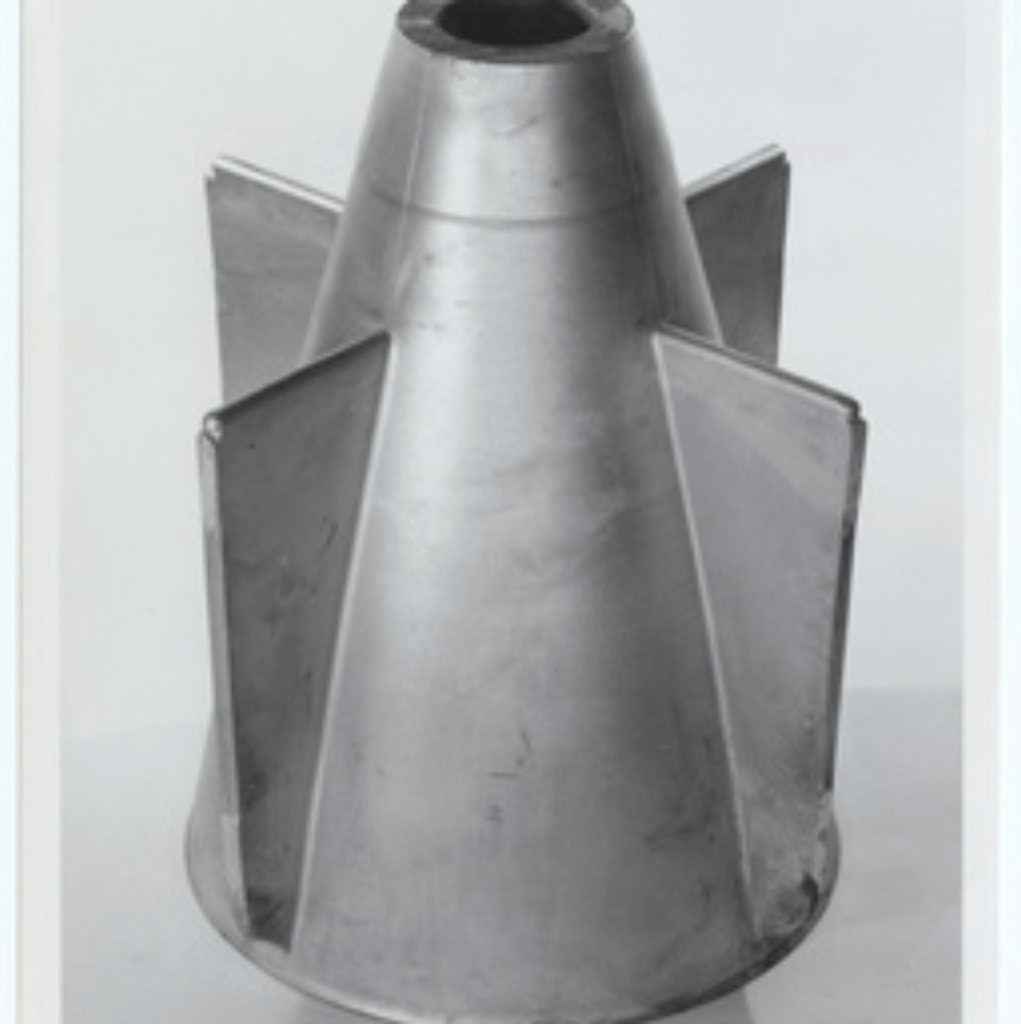
The torpedo tail piece (above) was moulded by Castalloy in North Plympton about the same time in 1966 as when the Beaumont Children disappeared, so “Harry” was still involved with secret Government business at the time.

The sister company (Vic Castalloy Pty Ltd) established in February 1949 by Laurie Green went on to parallel the Defence activities of the Waymouth Street Castalloy by manufacturing and supplying military hardware and parts to the Victorian requirers of such equipment. It was located at 12 Lily Street Coburg and would be registered as an International Defence Supplier to countries in the NATO Alliance and many other International Defence Conglomerates, as well as local needs.
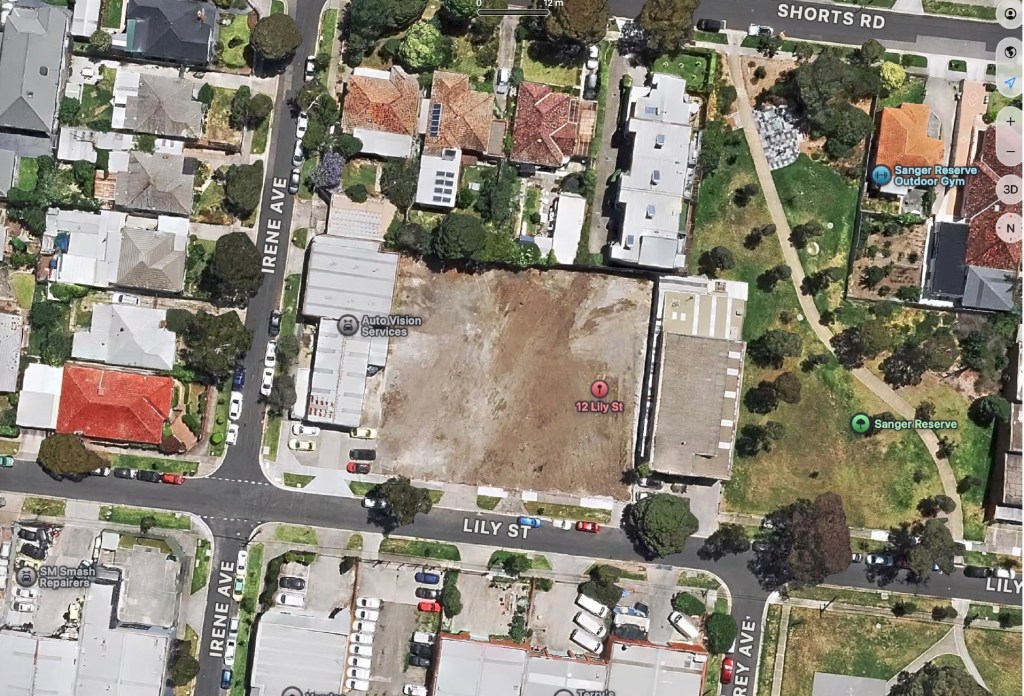
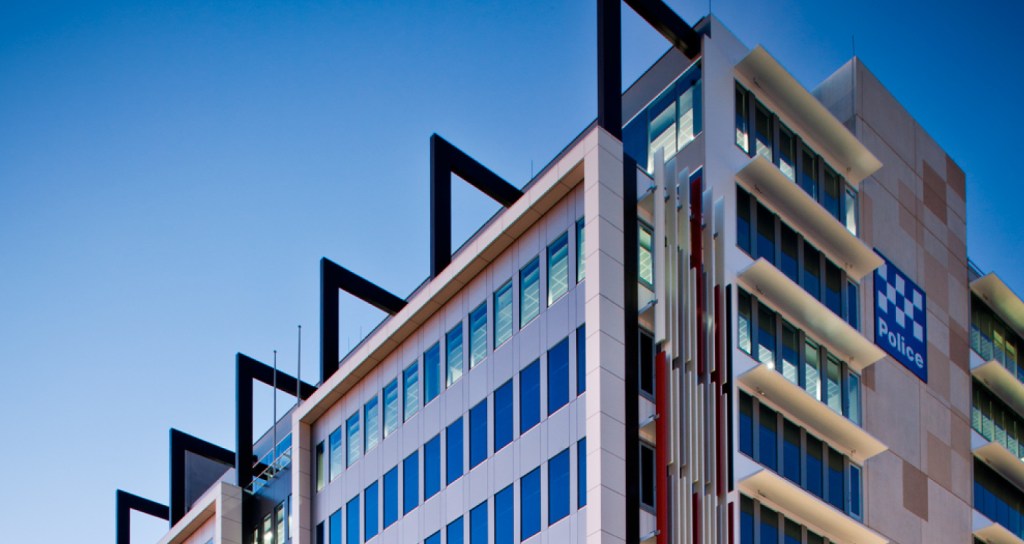
Castalloy supplied the aluminium sun shades for the new SAPOL building in 1965.

Take me to the Contents Page please!
To backtrack and brush up on what this case is about, go to Wikipedia here
To contact the author email onsomertonbeach@onsomertonbeach.com

 On Somerton Beach
Leave a comment